In medical animation the stakes are very high. Any mistakes made can have the power to extend campaign timelines, halt a product launch, erode authority in the eyes of healthcare professionals and misguide patients. After all, scientific accuracy isn’t something that can be applied at the end of a project. At Fusion Animation, it sits at the core of every step of a medical animation production.
Keeping on track of the pharma MLR process
For our pharmaceutical and biotech clients, there are three key deliverables that pass through MLR: script, storyboard and animation. In each case, they are built with MLR in mind from the start. Ultimately, no video is going to be released without your final approval. Each part of our process includes a round of review for your core team and then an additional round of review from your MLR team. It is a collaborative effort to make sure that the material the MLR team sees is as accurate as possible. Then we can easily incorporate any changes they may have.
Script
Before we start writing the script we conduct a literature review including published papers, trial data (e.g., Posters or Phase III results), and internal decks. When combined with the brief, this allows us to produce a document which outlines the narrative with claims that must be defended during the MLR review. The fleshed out written script is accompanied by a description of the footage for each frame and a marked up reference pack. This MLR-ready script helps capture any early-stage risks or concerns before production starts.
Storyboard
The storyboard evolves to become a sequence of still images from the future animation. They’re full colour and fully rendered so all reviewers have an accurate impression of how the video will look. Every slide includes the accompanying voice over, any on-screen labels and all-important disclaimers or footnotes. This is a comprehensive document that should include any mandatory information such as scrolling ISI or Summary of Product Characteristics.
The storyboard also enables the MLR team to check for any unintended visual claims. For example, showing a product completely blocks a pathway when actually the situation might be more nuanced. Our expertise usually means these scenarios don’t make it to the storyboard but this stage of review adds peace of mind.
Animation
By this stage, thanks to the clarity of the previous rounds, everyone involved in the review should have a clear idea of what to expect at this final stage. We often find that there are no or hardly any changes. The most likely request is to update the date of preparation or amend the job code post-approval. If data evolves after the video has been launched, we can easily update the relevant section of the video to keep it current and ensure longevity.
[[related-blog]]
Script writing and referencing
While essential, in our experience, scientific accuracy alone is not enough to make a good medical animation. The script needs to deliver an interesting story, with information released in a logical sequence and with the right level of detail. However, biological processes are rarely this neat or sequential. At this stage of the process, the main challenge is to get the right level of simplicity without losing nuance or at the expense of accuracy.
Here at Fusion, the creative team (most of whom also have a BSc or MSc) works closely with our PhD medical writers in order to establish the right balance between the science and the cinema, as early as possible. We have a breadth of experience across a range of therapeutic areas (you can see our range of expertise here). If the project requires additional specialist knowledge, we turn to a pool of external experts whose input we can draw on.
The all important brief
Of course the brief is fundamental to this process. We need to make sure the level of knowledge and detail is tailored to the prospective audience. The script for a patient video would differ from one for investors or HCPs. In other words the script ensures the right level of scientific accuracy for the right audience for each video.
Sequence of information - logic and scale
In most cases, the events occurring with a biological process such as the mechanism of a disease are not sequential. Usually many things are happening in parallel. Our job is to apply order to tell a story that people can follow. This is usually a judgement call based on our collective expertise so it captures the key scientific principles we’re discussing.
In addition to narrative flow, we need to consider the visual flow. Often our videos travel from outside a patient all the way down to the cellular level. Again, here we use our experience as well as reference visuals from published journals or reputable sources, to ensure the relative scales are acceptable as we make that journey.
Referenced script
Of course, every sentence of every script has to be supported by a published reference from a peer reviewed journal. This script is maintained throughout the creative process to ensure that each frame of the animation is clearly referenced. Each animation ends with a reference list and any necessary safety information or product characteristics.
At times the mechanism isn’t fully established in the literature. Here we have to ensure we show the parts that have been clearly elucidated and avoid straying into uncertain territory. In other circumstances, there can be disagreements across the literature for example of certain terminology. Here it can be helpful to have input from an advisory board to build consensus or strip the script back to key principles.
Then the challenge moves from accuracy to clarity and keeping viewers hooked. One of many tips the medical writers use is to match the sentence structure to the on-screen action as closely as possible. In other words, mentioning our hero character (whether that’s a drug, protein or cytokine for example) at the start of the sentence when they appear on screen. It’s much easier for the audience to absorb the information when the audio and visuals are in step.
In summary, scientific accuracy is the starting point built on solid, fully referenced foundations and a tight brief. The magic is then developing a script perfected for animation.
Storyboarding
We start by breaking the script down into scenes to manage the flow of information. Each scene is then sketched using inspiration and references from our extensive back catalogue, current scientific literature as well as any client reference material. If relevant, 3D models are built (see more on that below), environments created, colour palettes chosen. This is the first stage where the visual creative process meets the crafted script.
Much of the scientific groundwork has been done by the script. However, many of the challenges are the same at storyboard. Is the level of detail correct? Are the visual simplifications still accurate?
The storyboard can be a useful stage at which to gather broader input. For example, would it be useful to have a KOL give their input into certain terminology that is evolving at the moment. Or perhaps an Advisory Board would be a useful step if the science is contentious. The storyboard is a useful tool for gathering meaningful feedback to help ensure scientific accuracy, especially in a changeable environment. It is also a stage in the process where change is still possible. It’s much less expensive to make significant changes at the storyboard stage than at animation.
3D modelling
When the asset creation process begins for a realistic 3D medical animation, our team looks to utilise as much real world data as possible. This includes CAD models for medical devices, MRI scans for organ and tissue models and PDB datasets for protein and drug molecule models.
CAD files
Using Computer-Aided Design (CAD) files provided directly by medical device engineers ensures a high level of precision.
Initially these files are not optimised for the 3D animation pipeline and therefore need to be cleaned up and prepared. Fair warning; this next section is for the more technically minded reader. The preparation usually involves us finding the most appropriate import settings to get the right level of mesh tessellation and ensure correct object hierarchy to allow for any shading and rigging that follows. This ensures the medical device is represented in the best possible way.
For a recent medical device animation of a mechanical thrombectomy procedure, our team was supplied with a selection of CAD models, including a C-arm and an operating table. The C-arm needed to be rigged for a full range of motion as required by the animation script. Having these real world assets adds a good grounding to an animation, allowing for more creativity in other departments, such as lighting and animation.
MRI scans
These scans produce a stack of 2D images that software can compile into a 3D volume. The volume can then be converted into a 3D surface. We have used this technique to create highly accurate 3D models of brains and blood vessels for some of our projects.
In one such project our team was tasked to animate a microrobot in a very specific blood vessel located in the brain. The blood vessel was constructed using data from an MRI scan. As always the first step was to clean up and optimise the generated 3D mesh. This is needed because some of the noise in the underlying 2D images carries over to the 3D model.
PDB datasets
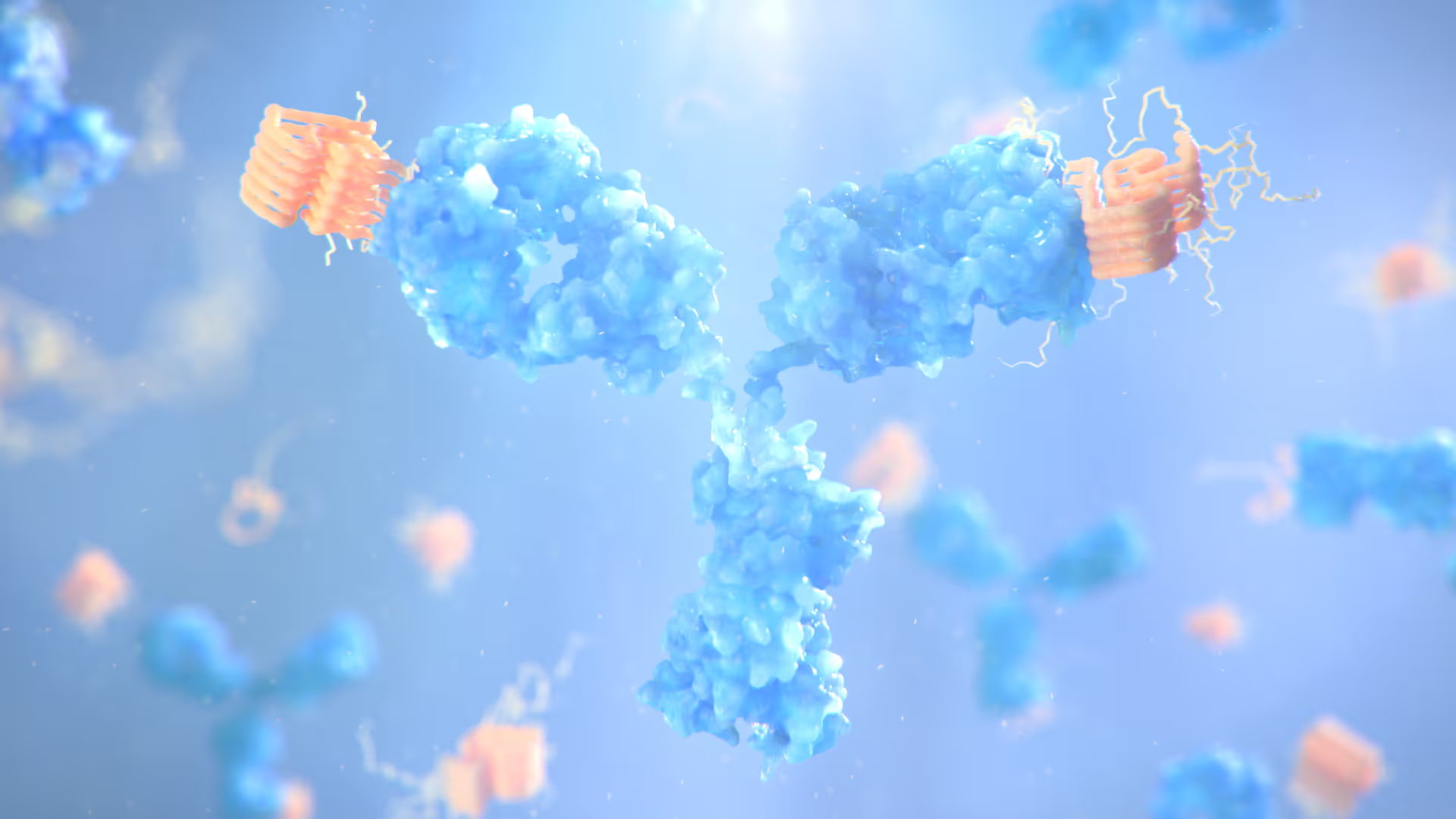
We use these databases extensively. Unless agreed otherwise, we would almost always start with sourcing the required molecules from RCSB PDB, DrugBank or similar sites. Since these files are essentially very long text files, our production software doesn’t natively know what to do with them in order to create 3D models. For this we turn to software like PyMOL or Chimera, specialised in viewing and exporting molecules in various other formats, including 3D meshes. Here our team can choose which elements to isolate and export in a production-friendly format. We usually include surface, ribbons and ball-and-stick representations.
Once the scientifically accurate protein or drug model is loaded in our main 3D software, we decide the level of detail and art direction, depending on the project. In some projects, where a molecule is still in development, we find the closest-matching molecule in a database and perform some manual additions and tweaks to the structure.
Animation
By the animation stage, we have locked in many of the key foundations of scientific accuracy. The use of accurate sources to build the 3D assets, attention to scale and context from the storyboard as well as the first pass MLR means that at the animation phase, we can make the fullest use of artistic license.
In a mechanism of action (MoA) animation, it is always necessary to greatly simplify the way things move in our animations. For example, creating a realistic molecular environment with Brownian motion would only overwhelm and confuse the viewer. Instead, we strive for clarity and elegance when telling these stories.
A great way to achieve this is to employ Disney’s twelve basic principles of animation. The use of easing to introduce realistic acceleration and deceleration, squash and stretch to make believable deformations and overlapping action for an added secondary animation. These techniques help ground the movements and make them appear like they’re governed by the basic laws of physics. While we’re not in the business of making the next Toy Story, we also enjoy using some of the more character animation-specific principles to add some personality to a hero molecule where relevant.
As an example, a hero antibody could move fluidly, with a subtle bounce, while a small-molecule drug could be depicted as a more rigid entity with a more constrained movement palette.
Sometimes, however, it is possible to use real world data directly in our animations. For example, we can use motion capture data from real patients to drive the movements of our digital humans.
Summary
Scientific accuracy is the foundation of every project we work on, not just a checkmark. It builds from the first literature review through to final MLR sign-off, and every stage adds its own layer of scrutiny: a referenced script, a storyboard your reviewers can interrogate, 3D assets built from real data, and an animation process designed to give your MLR team no surprises.
If you're planning a project and want to talk through how this would work for your therapeutic area, please do get in touch.
Or feel free to check out some of our medical animation examples in our Case Studies if you’d like to learn how we tackle common visualisation challenges within your therapeutic area.
FAQ
Do you have in-house medical/scientific staff, or do you rely on external experts?
Both. Our creative team is predominantly made up of people with a BSc or MSc, and we work closely with in-house PhD medical writers from the earliest script stage. Where a project needs additional specialist knowledge - a niche mechanism or an evolving area of the literature - we bring in external experts or KOLs to support the team.
How do you ensure the science in a medical animation is accurate before it reaches us?
Accuracy is built in at every stage, not checked at the end. Every sentence of the script is supported by a published, peer-reviewed reference. Storyboards are reviewed for the same level of detail and visual accuracy as the script. 3D assets are built from real data - CAD files, MRI scans, or PDB datasets - rather than generic stock models. By the time a project reaches animation, the underlying science is already locked in.
Who has the final sign-off on scientific accuracy - us or you?
You do. Our process is designed to catch issues early so your review rounds are as smooth as possible, but every script, storyboard, and animation passes through your team and your MLR process before anything is approved for release.
Do artistic choices like colour or animation style affect the accuracy of a mechanism of action?
No. By the animation stage, the aspects that must stay true to the science - binding order, molecule orientation, conformational changes - are already fixed from the script and storyboard. Colour, lighting, and motion style are used to aid clarity and visual storytelling, not to change what's being depicted.
What happens if our internal experts disagree with the published literature (or with each other)?
This occasionally comes up, particularly in areas where the science is still evolving or terminology hasn't settled. In these cases, we'd typically recommend an advisory board to help build consensus, or strip the relevant section back to the most well-established principles rather than depict a contested detail.
Do you use real patient data or clinical scans in your animations?
Where relevant, yes - for example, MRI scans to build anatomically accurate models of blood vessels or organs, or CAD files supplied by device engineers for medical devices. These are used purely as structural references for the 3D models, not as identifiable patient data.