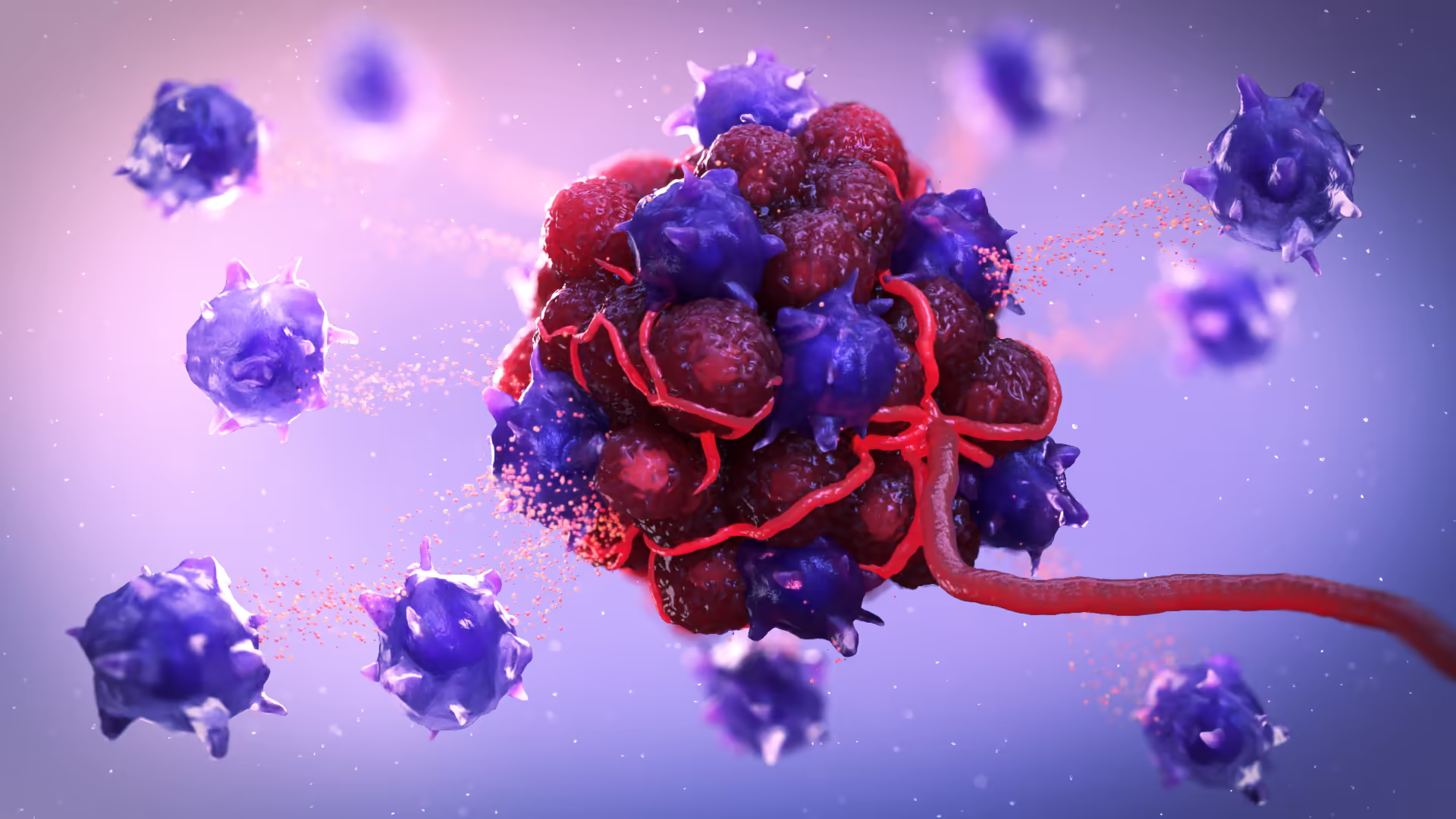
Visualising an innovative dual mechanism of action.
Blocking Transcription in Small Cell Lung Cancer (SCLC)
PharmaMar approached us with a challenge: could we explain Lurbinectedin's dual action as treatment for small-cell lung cancer (SCLC) to an audience who weren't fluent in transcriptional biology?
Client:
PharmaMarObjective
- Show the dual mechanism of action in tumour and TAMs.
- Remind viewers of transcriptional biology.
- Illuminate this novel, dual mechanisms of action.
Results
- Delivered long-lasting medical education asset.
- Content stayed relevant despite varied trial data.
- Drove deep clinical engagement with upcoming trial data.
Outcome
A dual purpose animation for a dual action drug.
We provided an animation that explains transcription biology before highlighting Lurbinectedin's dual action.
Lurbinectedin works two ways at once: it blocks transcription inside small-cell lung cancer (SCLC) tumour cells, and in tumour-associated macrophages (TAMs) in the surrounding microenvironment. However, much of the audience wouldn't be fluent in transcriptional biology, and so we had to take a more nuanced approach.
Fusion built a 3D medical animation that lead with the underlying transcription biology clearly and concisely, providing enough knowledge for viewers to train their focus on the mechanism of action of Lurbinectedin.
The Brief
In February 2023, PharmaMar asked us to build an unbranded 3D medical animation explaining the MoA of lurbinectedin (Zepzelca) in SCLC. The audience was lung cancer physicians and oncologists – clinically fluent, but not necessarily versed in DNA transcription or in this particular mechanism, which the brief flagged as something many would be encountering for the first time.
SCLC is a challenging area: it accounts for around 15% of lung cancer diagnoses1, has a poor prognosis, and – at the time of the brief – no recent approvals. The goal of this video was to refresh viewers on the underlying transcription factors to enable a deeper understanding of the different strands of the mechanism. It was strictly limited to the MoA and not to stray into any clinical effects.
How do you explain a dual mechanism of action in two minutes?
Often the MoA animations we're asked to build have one central idea to explain. This one had two, and they are interlinked:
Transcriptional addiction in the tumour cell
Lurbinectedin binds guanine-rich promoter regions of transcriptionally active DNA, blocking oncogenic transcription factors and stalling RNA polymerase II. That prevents the downstream production of essential proteins, and so stops SCLC tumour cells from proliferating or migrating.
A second effect on tumour-associated macrophages (TAMs)
The same transcription-inhibiting mechanism also acts on TAMs within the tumour microenvironment, reducing the cytokines that drive tumour growth and vessel formation.
DNA transcription in particular isn't something most oncologists mull over on a daily basis. The film therefore had two jobs to do within two minutes: teach enough transcription biology for the mechanism to land, and keep the tumour cell and TAM effects legible as one dual mechanism, rather than as two separate ideas competing for attention.
Our Approach
We built the film as a single continuous journey from the lung, through the microenvironment, into the cancer cells and down into the nucleus to help orient the viewer. We then focussed on the specific guanine-containing triplets on the DNA strand where the lurbinectedin binds.
A split screen enabled us to compare the downstream impact with and without the drug. This helped us to show the lack of something (a common challenge we face). In this case, a lack of transcription, which in turn stops protein production.
Once the principles of the impact of inhibiting transcription had been shown, we could then move on to the TAMs within the tumour microenvironment. Here we were able to pull back and show the impact of lurbinectedin on cytokine production without needing to go back into the nucleus of the TAMs.
A postscript, three years on
It's worth setting this in context, because it explains why the limits of the script, i.e. what was left out, matter as much as what was included. When this animation was commissioned, lurbinectedin had held FDA accelerated approval since June 2020 for second-line metastatic SCLC2, on the strength of response-rate data from a single-arm Phase 2 trial. That approval came with a condition attached: continued approval depended on verifying clinical benefit in a confirmatory trial. Jazz Pharmaceuticals and PharmaMar had begun that trial – LAGOON, a Phase 3 study – in December 2021, so by the time of this brief, PharmaMar was mid-journey: a drug with a novel mechanism and second-line uptake, but with its longer-term footing still resting on a trial yet to read out.
That backdrop is why the focus of the video was very specific – detailed information about the mechanism, without overstating a clinical story that was, at that point, still being determined.
As of July 2026, the lurbinectedin story has moved on. The original confirmatory trial, LAGOON, reported topline results in June 2026 and did not meet its primary endpoint of overall survival for lurbinectedin – alone or combined with irinotecan – against investigators' choice of chemotherapy in the second-line setting this animation was originally built for3. Jazz Pharmaceuticals and the FDA are now working through the post-marketing requirements attached to that specific indication.
At the same time, the drug's footing elsewhere has strengthened considerably. A separate Phase 3 trial, IMforte, reported statistically significant improvements in overall survival and progression-free survival in October 2024 for lurbinectedin combined with atezolizumab as a first-line maintenance treatment in extensive-stage SCLC4, and that combination received full FDA approval in October 2025. The mechanism this animation explains hasn't lost relevance – if anything, it now underpins a stronger, fully-approved indication in a different, earlier line of treatment, alongside the ongoing conversation about the second-line indication the film was originally built to support.
For us, that's a useful reminder: an MoA asset built around the biology, rather than around a single indication, tends to remain relevant well beyond the specific approval that commissioned it.
References
1. Pincott J, Kanchustambham V. Small cell lung cancer. In: StatPearls [Internet]. StatPearls Publishing; 2026. Updated April 15, 2026. Accessed July 30, 2026. https://www.ncbi.nlm.nih.gov/books/NBK482458/
2. US Food and Drug Administration. FDA grants accelerated approval to lurbinectedin for metastatic small cell lung cancer. FDA.gov. Published June 15, 2020. Accessed July 30, 2026. https://www.fda.gov/drugs/drug-approvals-and-databases/fda-grants-accelerated-approval-lurbinectedin-metastatic-small-cell-lung-cancer
3. Jazz Pharmaceuticals plc. Jazz Pharmaceuticals provides update on Zepzelca® (lurbinectedin) Phase 3 LAGOON trial in second-line small cell lung cancer. News release. Jazz Pharmaceuticals; June 12, 2026. Accessed July 30, 2026. https://www.prnewswire.com/news-releases/jazz-pharmaceuticals-provides-update-on-zepzelca-lurbinectedin-phase-3-lagoon-trial-in-second-line-small-cell-lung-cancer-302798651.html
4. Jazz Pharmaceuticals plc. Jazz Pharmaceuticals announces statistically significant overall survival and progression-free survival results for Zepzelca® (lurbinectedin) and atezolizumab combination in first-line maintenance therapy for extensive-stage small cell lung cancer. News release. Jazz Pharmaceuticals; October 15, 2024. Accessed July 30, 2026.
More Case Studies
The proof is in the pudding. Check out our previous solutions for more insight into how we can help.
Add real value to your project.
Our clients see real results with our animations across a broad range of use-cases.
Mechanism of Disease
Bring the complex cellular and molecular drivers of disease to life through immersive, step-by-step storytelling.
Mechanism of Action
Differentiate, educate and excite with a visual representation of your drug’s unique properties.
Explainer Animations
Break down intricate concepts into clear, dynamic animations designed to resonate with a broader, non-expert audience.
Investor Presentations
Secure funding with high-impact, cinematic visuals that communicate scientific potential louder than words.
Data Visualisation
Turn complex datasets into a compelling, easy-to-follow animated journey that eliminates data overwhelm.
Clinical Trial Recruitment
Use engaging, empathetic motion graphics to demystify trials and encourage enrolment.
Patient Education
Accessible, sound-enhanced animations that help patients truly understand their condition and treatment journey.
Internal Training
Move beyond slides with engaging content that explains the science behind your latest asset or clarify what HEOR really is.
Commercial Launch
Deploy strategic, high-energy animated assets that drive prescribing habits and capture attention.