
“Again: fantastic video. Thanks!”
Chief Medical Advisor, Lundbeck

When a leading scientific publisher, Nature Neuroscience, asked Fusion Animation to translate cutting-edge research into a compelling visual narrative, we knew the challenge: to make microscopic changes inside the brain both understandable and emotionally resonant. The resulting medical animation offers a journey from molecules to memory loss, and empowers the audience to grasp what happens inside Alzheimer’s disease.
The goal was clear: create a high-impact medical animation that explains the progression of Alzheimer’s disease (key molecular, cellular and physiological mechanisms) in a way that’s scientifically accurate. The client needed a piece that could serve both as an educational tool and as a shareable outreach asset.
Alzheimer’s disease involves multiple overlapping processes (amyloid-β, tau tangles, inflammation, cell death) and communicating that in a few minutes requires clarity and pacing.
The animation had to speak both to specialists (who demand scientific rigour) and to lay audiences (who need simplified framing) without alienating either.
Many of the events (protein clumping, synapse loss, neuronal degradation) happen at micro-scales or over long time spans — turning these into compelling visual metaphors was key.
Alzheimer’s is emotionally charged (impacting patients, families, carers). The animation needed scientific objectivity, but also empathy and respect.
Working within client branding, style guidelines and time duration demanded tight creative decisions around pace, colour, narration, transitions.
We began with a storyboard phase, mapping the full sequence from healthy synapse → early amyloid accumulation → tau pathology → cell death → memory/tissue loss. By plotting a visual “journey inside the brain”, we gave the viewer an intuitive progression.
In collaboration with the client’s neuroscience team, we distilled the science into core message pillars, so each visual segment had a clear takeaway.
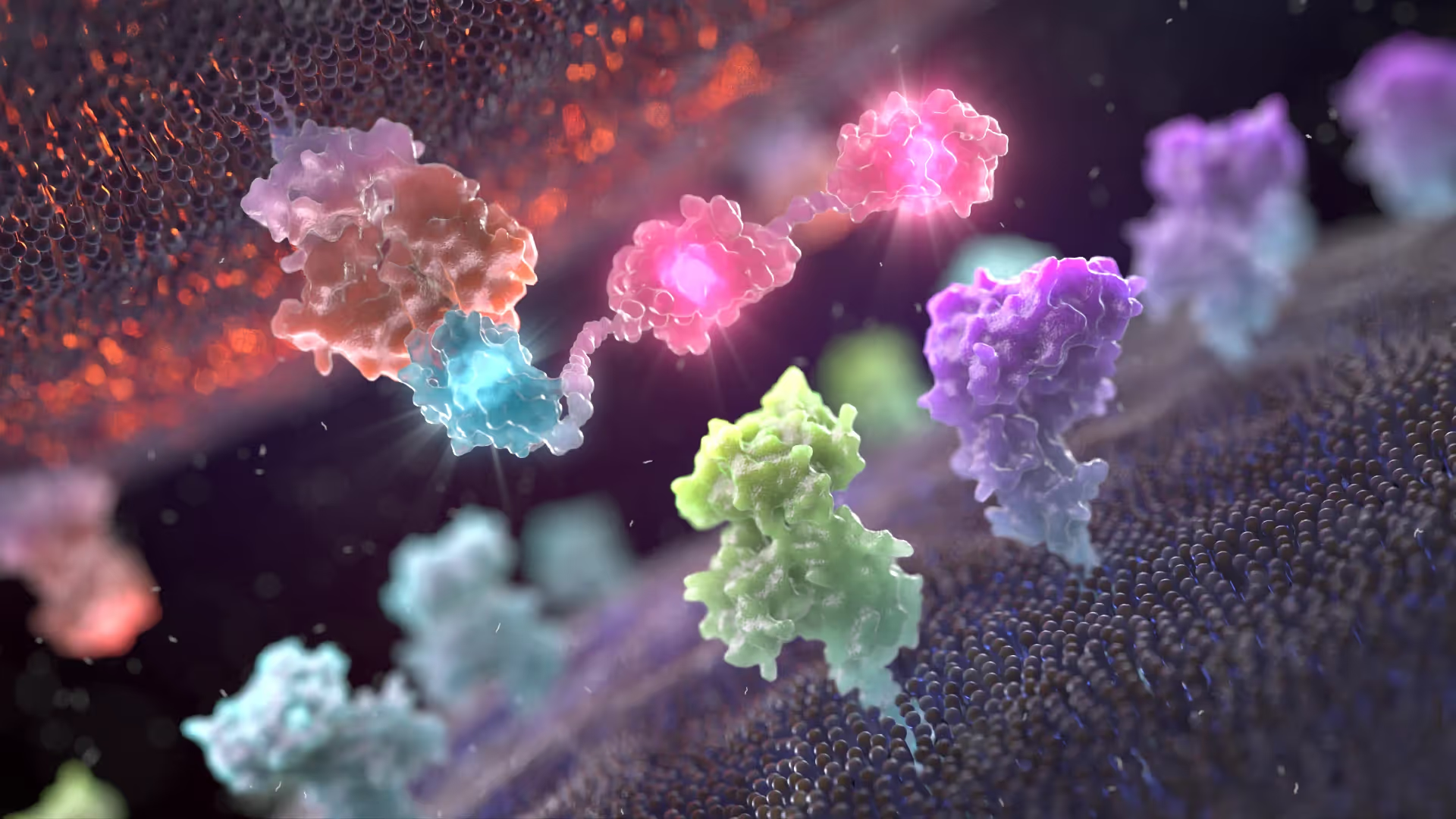
Visually, we chose a semi-realistic style: enough detail to feel “inside the brain”, but stylised enough to avoid overwhelming the viewer with microscopic minutiae. We used macro/s micro-scale transitions to bridge the large-scale brain map to the tiny molecular events.
For emotional tone, we integrated ambient design cues: shifts in light, colour filters and pacing to signal deterioration subtly, without sensationalising.
We also produced a version optimised for multiple platforms (web embed, mobile, social-share) to extend reach beyond just a journal article context.
We turned a deep-dive into Alzheimer’s disease into a vivid, accessible visual narrative — helping audiences literally see the journey from molecular change to memory loss, and empowering our client to bridge the gap between research and the real world.
[[video=199836750]]
The medical animation has been used by the client as both a public outreach asset and a research-education tool, reaching broader audiences than standard academic visuals. It was received very popularly by an online audience, getting over 550,000 views on the Nature YouTube channel.
For Fusion Animation, it reinforced our reputation in the “science-to-animation” space: demonstrating that complex research can be transformed into compelling, shareable visual narratives.
The medical animation explains the progression of Alzheimer’s disease, from healthy brain cells through the accumulation of pathological proteins and synaptic loss, to the resulting memory and cognitive decline.
The piece was created by Fusion Animation for Nature Neuroscience and uses a scientific narrative developed in collaboration with neuroscience experts.
It bridges high-level scientific content and viewer-friendly storytelling, using a visual journey inside the brain to make molecular events accessible and emotionally resonant.
To create an engaging outreach and educational asset that increases understanding of Alzheimer’s disease mechanisms, drives awareness and facilitates communication across disciplines.
We employed a semi-realistic visual style, clear narrative progression, multiple platform formats (web, mobile, social) and collaborated with scientific consultants to ensure accuracy while remaining understandable.

3 things to look for in a medical animation supplier
Aug 2024
Opinion
OUR CLIENTS


Can we bring you clarity?
Please contact us using the details below.
Office
410, Highgate Studios,
53-79 Highgate Road,
London NW5 1TL0
T +44 (0)207 127 6935
M +44 (0)7970 080 690
info@fusionanimation.co.uk