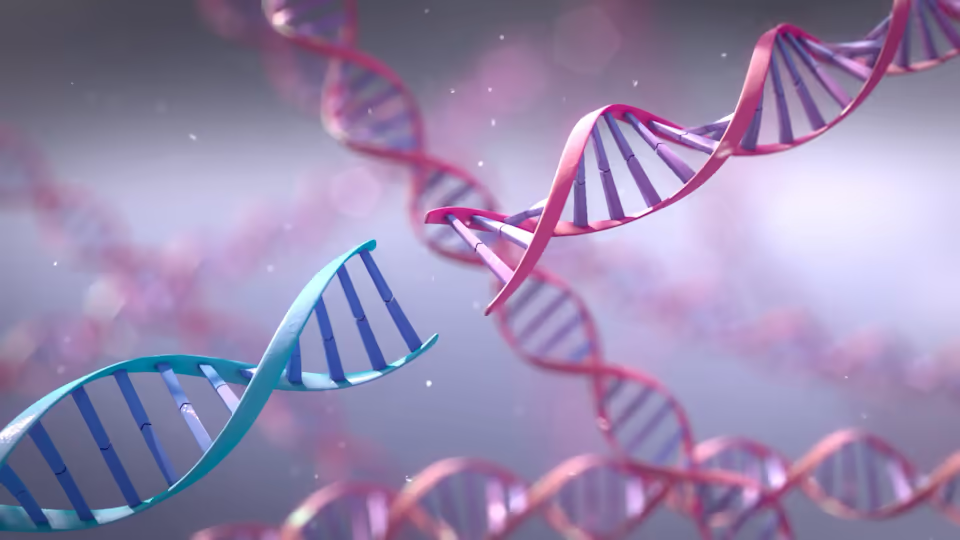
Learn how Fusion showed cancer treatment potential in the MAPK pathway with precise, cinematic 3D medical animation.
One pathway, three variations.
The therapy only makes sense once you can tell those variations apart. How do you show such a detailed process so many different ways in only two and a half minutes?
Client:
Day One BiopharmaceuticalsObjective
- Describe the normal MAPK pathway function as a foundation.
- Show the resilience of MAPK driven tumors due to pathway variation.
- Demonstrate the potential of DAY101 as a treatment.
Results
- Helped secure funding for continued development and trials.
- Since development, DAY101 is now named tovorafenib, sold as Ojemda.
- European Commission has approved conditional marketing authorisation.
Outcome
Making biomarker differences visible on screen
We built a Mechanism of Action animation walking through variations in MAPK signalling for easy understanding and comparison.
Back in 2022, Day One Biopharmaceuticals was a clinical-stage biotech running FIREFLY-1, an early trial of a molecule then known only as DAY101, in children with relapsed or refractory low-grade glioma - the most common brain tumour diagnosed in children.1 The drug's rationale sat on the MAP kinase, or MAPK, pathway: the RAS–RAF–MEK–ERK signalling cascade that, in various mutated forms, drives a large share of paediatric and adult cancers. This case study is one of our medical animation examples of taking a genuinely technical pathway and building an asset that could carry the scientific story from investigator meetings through to launch.
References
1. U.S. Food and Drug Administration. FDA grants accelerated approval to tovorafenib for patients with relapsed or refractory BRAF-altered pediatric low-grade glioma. Published April 23, 2024. Accessed August 13, 2026.
The challenge
The MAPK pathway isn't difficult to describe in outline. Growth factor signals cross the cell membrane, RAS proteins activate, RAF dimerises, and a chain of kinase activation eventually switches on genes that drive cell division. The harder task was showing why DAY101 mattered: not every MAPK-driven tumour is broken in the same way, and the differences are exactly what determine whether a patient is eligible for treatment.
We built the animation to move through several related but distinct scenarios, in sequence:
- Normal signalling - growth factor binding drives an orderly chain of activation from receptor to nucleus. [[00:22]]
- RAS mutation - the RAS protein becomes locked in an active state, regardless of upstream signals. [[01:12]]
- BRAF V600E mutation - the RAF protein itself is constitutively active, independent of RAS. [[01:26]]
- RAF gene fusions - a hybrid protein loses its usual autoinhibition and drives signalling on its own. [[01:42]]
Rather than collapsing these into a single ‘the pathway is broken’ moment, each state needed to read as its own event. We used the same visual language (the same RAS, RAF, MEK and ERK molecules, the same membrane, the same colour cues for activation) so a viewer could compare one alteration against another. That consistency, done well, is what turns a mechanism of action animation into a genuine reference tool rather than a one-off explainer.
A genuinely joint effort
This project was a collaboration in the fullest sense: a specialist agency partner wrote and referenced the script against the primary literature, and Fusion turned it into a storyboard and finished 3D medical animation, shot by shot. Its great - the science arrives fully vetted, and we can focus entirely on finding the clearest way to show it.
Where Day One is now
DAY101 has since become tovorafenib, sold as Ojemda. In April 2024, the FDA granted accelerated approval for relapsed or refractory paediatric low-grade glioma harbouring a BRAF fusion or rearrangement, or a BRAF V600 mutation – the first FDA-approved systemic therapy for this patient group.1 The approval was based on FIREFLY-1 data showing a 67% overall response rate.2 A companion diagnostic followed in January 2025,3 and Day One is now running FIREFLY-2/LOGGIC, a Phase 3 trial testing tovorafenib as a front-line therapy against chemotherapy.2 In April 2026, the European Commission granted conditional marketing authorisation for Ojemda across the EU, Iceland, Liechtenstein and Norway, through Day One's licensing partner Ipsen.4
Why the pathway story mattered
None of that changes the underlying communication problem: BRAF fusions, BRAF V600E and RAS mutations produce meaningfully different biology, and a clinician or KOL needs to hold all three in mind to understand who a BRAF-altered therapy is actually for. An animation that treats ‘MAPK pathway alteration’ as one undifferentiated idea doesn't help with that. One that walks through each state on its own terms does.
That's not a challenge unique to paediatric glioma. The same RAS/RAF/MEK/ERK biology, mutated in largely the same handful of ways, turns up in melanoma, non-small cell lung cancer, colorectal cancer and thyroid cancer. For any Medical Affairs team bringing a MAPK-pathway asset to a congress audience, the same underlying design problem applies: how to help people tell one alteration apart from another quickly, without losing the thread of why it matters clinically. It's a problem we like solving, and one we're always glad to hear from pharmaceutical and biotech companies about.
References
1. Day One Biopharmaceuticals, Inc. Day One's OJEMDA (tovorafenib) receives US FDA accelerated approval for relapsed or refractory BRAF-altered pediatric low-grade glioma (pLGG), the most common form of childhood brain tumor. Published April 23, 2024. Accessed August 13, 2026.
2. Drug Topics. FDA grants tovorafenib approval to treat relapsed or refractory pediatric low-grade glioma. Published 2024. Accessed August 13, 2026.
3. Foundation Medicine, Inc. U.S. Food and Drug Administration approves FoundationOne CDx as a companion diagnostic for OJEMDA (tovorafenib) to treat the most common form of childhood brain tumor in pediatric patients. Published January 17, 2025. Accessed August 13, 2026.
4. Ipsen. Ojemda approved in the European Union as the first targeted therapy in relapsed or refractory pediatric low-grade glioma regardless of BRAF alteration. Published April 22, 2026. Accessed August 13, 2026.
More Case Studies
The proof is in the pudding. Check out our previous solutions for more insight into how we can help.
Add real value to your project.
Our clients see real results with our animations across a broad range of use-cases.
Mechanism of Disease
Bring the complex cellular and molecular drivers of disease to life through immersive, step-by-step storytelling.
Mechanism of Action
Differentiate, educate and excite with a visual representation of your drug’s unique properties.
Explainer Animations
Break down intricate concepts into clear, dynamic animations designed to resonate with a broader, non-expert audience.
Investor Presentations
Secure funding with high-impact, cinematic visuals that communicate scientific potential louder than words.
Data Visualisation
Turn complex datasets into a compelling, easy-to-follow animated journey that eliminates data overwhelm.
Clinical Trial Recruitment
Use engaging, empathetic motion graphics to demystify trials and encourage enrolment.
Patient Education
Accessible, sound-enhanced animations that help patients truly understand their condition and treatment journey.
Internal Training
Move beyond slides with engaging content that explains the science behind your latest asset or clarify what HEOR really is.
Commercial Launch
Deploy strategic, high-energy animated assets that drive prescribing habits and capture attention.